Showing posts with label Poses lying on back. Show all posts

Sunday, 3 June 2012

Shavasana - The Corpse Pose

Shavasana 


Posture

The name comes from the Sanskrit words Shava (शव, Śava) meaning "corpse", and Asana (आसन, Āsana) meaning "posture" or "seat". This is an Asana for relaxation of all muscles, nerves, etc. This Asana should be performed at the very end. It is a closing pose. Mritasana is another name for this pose.

Procedure

  1. Lie on your back.
  2. Take a breath in and tense your whole body from head to toes. Hold your breath, clench your fists, and squeeze all facial muscles as well as every single muscle in the body.
  3. Breathing out through the mouth with a “haaa” sound, release your muscles.
  4. Repeat once more.
  5. Now lie comfortably. Keep your eyes closed.
  6. Relax all parts of your body.
  7. Take your awareness to all parts of the body in turn, starting at the feet and ending with the head, feeling grateful for each part of the body. Gratefulness adds to the physical and mental relaxation.
  8. Let mother earth take all your weight. Feel the body to be very light. A relaxed body feels light.
  9. Next, allow your breath to relax by becoming aware of it and making it soft, small, and quiet.
  10. Now allow your mind to relax by letting go of any worries, fears, anxiety, or excitement. Surrender them all. For the time being, let go of any future plans or past events.
  11. Rest in the peaceful and blissful space within you.
  12. After resting for a few minutes, bring your awareness back to your body and take a few deep breaths.
  13. Gently roll over onto your right side.
  14. Slowly come up to the sitting position.
  15. Chant Om three times.
  16. Gently, taking your own time, open your eyes.

Benefits


  1. Relaxes your psycho-physiological system.
  2. Develops awareness of the body .
  3. It is Savasana that promptly and efficiently ensures complete relaxation and perfect ease.

Video


Halasana - The Plough Pose

Halasana


Posture

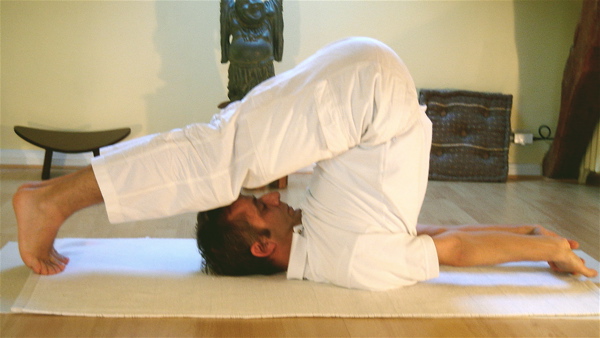
The name comes from the Sanskrit words hala (हला) meaning "plow" and asana (आसन) meaning "posture" or "seat" .When this pose is practised, it gives the exact appearance of a plough. Hala means a plough in Sanskrit.

Caution: If you have had abnormal blood pressure, glaucoma, detached retina, chronic thyroid disorders, neck or shoulder injuries, consult your teacher and physician before doing the shoulder stand

Procedure


  1. Go into the shoulder stand. Keep the back supported with your hands.
  2. Breathe in. Keeping the left leg straight up, exhale and lower the right leg to the floor behind the head.
  3. Breathing in, lift the right leg straight up.
  4. Breathing out, lower the left leg to the floor. Keep the right leg up.
  5. Breathing in, lift the left leg up.
  6. Breathing out, lower both the legs to the floor. Keep the spine erect. If the feet do not reach the floor, don’t struggle to bring them down. Instead press them toward the wall behind you. Straighten the knees.
  7. If your toes reach the floor, move them in toward the head and straighten your spine. Press the knees up. Do not press the neck into the floor.
  8. If you don’t need to support your back with the hands, lower your arms to the floor, palms facing down. Breathe deeply and stay in the posture for 20-60 seconds.
  9. To come out of the posture, support the back with your hands. Lift the legs up and lower the spine to the floor, vertebra by vertebra, without lifting the head

Benefits

  1. This Asana tones the spinal nerves, the muscles of the back, the vertebral bones and the sympathetic nervous system that runs along the vertebral column on both sides. This Asana fulfils and amplifies Sarvangasana.
  2. A large quantity of blood is poured into the spinal roots of nerves, spinal cord, sympathetic ganglia, sympathetic nerves and muscles of the back. Hence, they are all well nourished. 
  3. The vertebral column is rendered very, very soft and elastic. 
  4. This Asana prevents the early ossification of the vertebral bones. Ossification is quick degeneration of bones. Old age manifests quickly on account of early ossification. The bones become hard and brittle in the degenerative process. He who practises Halasana is very nimble, agile, full of energy. 
  5.  The muscles of the back are alternatively contracted, relaxed and then pulled and stretched. Hence they draw a good supply of blood by these various movements and are well nourished.
  6. Various sorts of myalgia (muscular rheumatism), lumbago, sprain and neuralgia are cured by this Asana.
  7. The vertebral column becomes soft and elastic. It is twisted and rolled as it were like a piece of canvas sheet. A man who practises Halasana can never become lazy. 
  8.  The vertebral column is a very important structure. It supports the whole body. It contains the spinal cord, spinal nerve and sympathetic system. In Hatha Yoga the spine is termed as Meru Danda. Therefore you must keep it healthy, strong and elastic by the practice of Halasana. The muscles of the abdomen, the rectal muscles and the muscels of the thigh are also toned and nourished.
  9. Obesity or corpulence and habitual or chronic constipation, gulma, congestion and enlargement of the liver and spleen are cured by this Asana.

Video


Saturday, 2 June 2012

Chakrasana - Wheel Pose

Chakrasana


Posture

The name comes from the Sanskrit words Chakra (चक्र, Cakra) meaning "wheel", and Asana (आसन, Āsana) meaning "posture" or "seat".Many acrobats demonstrate this Asana in the streets. Young boys can do this Asana very easily because their spine is very elastic. When the bones become rigid and ossified in advanced years, bending of the spine becomes difficult. It resembles a circle. Hence the significant name Chakrasana. In fact, it resembles more a bow than a circle.

Procedure

  1. Lie on your back; feet together and hands relaxed by the sides. Take deep breaths in and out.
  2. Bend your legs and place the feet on the floor, close to the hips, wider than the hips.
  3. Stretch the arms away from the body in line with the shoulders, with the palms facing up.
  4. Gently bring both knees to the ground on your right side, keeping the feet close to the hips.
  5. Turn the head to your left to look at your left palm, keeping both shoulders on the ground.
  6. Press the knees and thighs to the floor without lifting the shoulders. Hold.
  7. Gently come back to the centre by bringing the legs up.
  8. Repeat on the other side.

Benefits

  1. He who practises this Asana will have perfect control of the body.
  2. He will be agile and nimble. He can turn out more work in a short space of time. All the parts of the body are benefited by this Asana.
  3. When you raise yourself upon this Asana the body will be light. You will get exhilaration of spirit at once.
  4.  You will be ready for active work. If there is any pain in the neck and shoulders after the practice of Sarvangasana, do this Asana immediately for a few minutes. 
  5. It will relieve the pain as it bends the neck backwards and thus it is a counter-pose to Sarvangasana.
  6. All the other benefits of Dhanurasana, Salabhasana and Bhujangasana are derived from this Asana.

Video


Thursday, 31 May 2012

Dhanurasana - The Bow Pose


Dhanurasana 


Posture

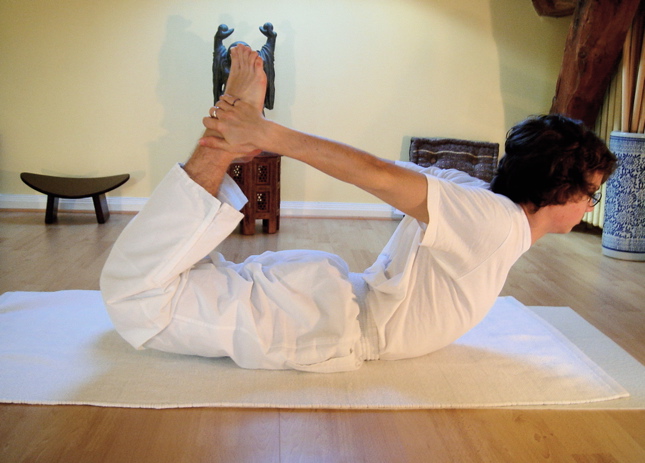
When this Asana is performed, it represents the appearance of a bow (Dhanus). The stretched arms and forelegs form the string of the bow. It bends the spine backwards. It supplements Bhujangasana. We can say it is a combination of Bhujangasana and Salabhasana with the addition of catching the ankles with the hands. Bhujangasana, Salabhasana and Dhanurasana form a valuable combination. They always go together. They form one set of Asanas. This combination acts as a counter-pose to Halasana and Paschimottanasana, which bend the spine forwards.

Procedure

  1. Lie on your abdomen, feet together, forehead on the floor.
  2. Bend your legs toward the hips and hold the feet at the ankles with your hands.
  3. Breathing in, raise the head, chest and knees up.
  4. Focus on widening the shoulders, bringing the knees together and lifting them higher.
  5. Straighten the elbows by pushing the hands away with the feet and lift the chin up.
  6. Hold and continue breathing in and out.
  7. Breathing out, gently come down and press feet down onto hips, press the thighs into the floorto stretch the quadriceps.Release and relax.

Benefits

  1. This is useful in chronic constipation, dyspepsia and sluggishness of liver.
  2. It removes hunchback, rheumatism of legs, knee-joints and hands.
  3. It reduces the fat, energises digestion, increases peristalsis, invigorates the appetite and relieves congestion of blood in the abdominal viscera and tones them also.
  4. Dhanurasana is a blessing for people who suffer from gastro-intestinal diseases.
  5. It keeps the spine elastic. It prevents premature ossification of bones.
  6. He who does Halasana, Mayurasana and Dhanurasana can never become lazy. He is full of energy, vigour and vitality.

Video