Sunday, 27 May 2012

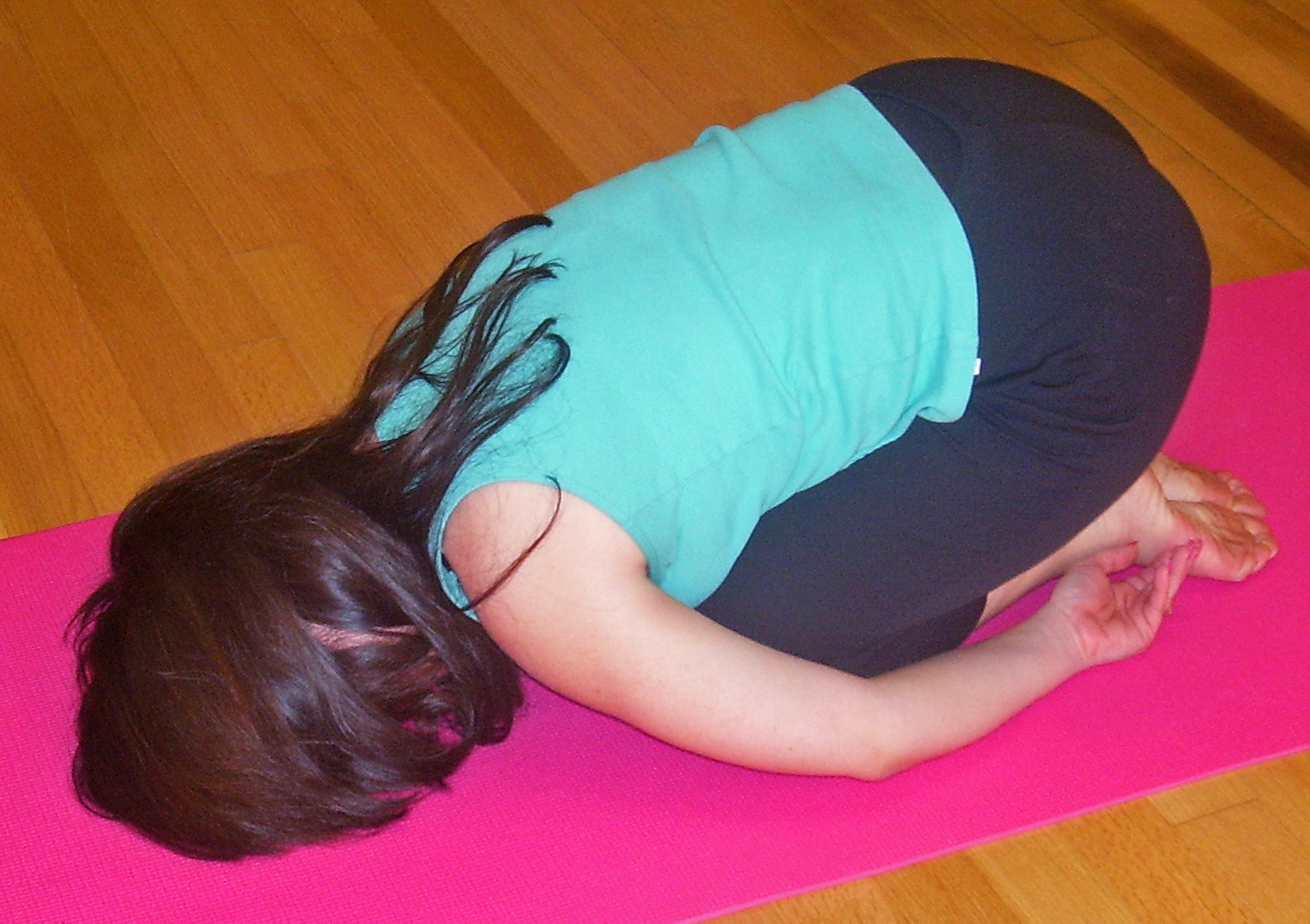
Yoga Mudrasana - Child Pose

Yoga Mudrasana


Posture

This asana is also known as balasana The name comes from the Sanskrit words bala meaning "child" and asana (आसन) meaning "posture" or "seat" .

Procedure

  1. Sit in Padmasana or sit on your heels. Keeping your hips on the heels, bend forward, and lower your forehead to the floor.
  2. Keep the arms alongside your body with hands on the floor, palms facing up. (If this is not comfortable, you can place one fist on top of another and rest your forehead on them.
  3. Gently press your chest on the thighs.
  4. Hold.
  5. Slowly come up to sit on the heels, uncurling vertebra by vertebra and relax.

Benefits

  1. This pose gently streches the hips thighs and ankles . 
  2. This also relieves back and neck pain when done with head and torso supported  .
  3. This pose calms the brain and relieves the tension and stress  to such a great extent and it is even said that if someone is going for suicide and you make him perform this pose then he will change his idea of suicide because of the stress busting quality of this pose 

Video


Janu Shirasasana

Janu Shirasasana


Posture

janu = knee
sirsa = head

Procedure

  1. Sit up with the legs stretched out straight in front of you, keeping the spine erect.
  2. Bend the left knee and place the left foot against the right thigh, keeping the left knee on the floor.
  3. Breathing in, raise both arms above your head and stretch up, and twist a little to the right from the waist.
  4. Breathing out, bend forward from the hip joints keeping the spine straight, directing your chin to the toes.
  5. If you can, hold on to your big toes and, pointing your elbows to the ground, move forward as you pull on your toes.
  6. Hold. Keep breathing.
  7. Breathing in, come up and breathing out, bring the arms down to the sides.
  8. Repeat on the other side.

Benefits


  1. Stretches  the spine, shoulders, hamstrings, and groins 
  2. Massages the abdominal organs and tones the shoulders
  3. Therapeutic for high blood pressure, insomnia, and sinusitis 
  4. Calming to the brain and helps relieve mild depression. 
  5. If one is not able to do paschimottan asana then he is made to practise this asana which made the muscles flexible to move into paschimottan asana after few days .

Video


Simhasana - Lion Pose


Simhasana


Posture

In Sanskrit language word “Simha” stands for Lion and also the seated pose of this asana is resembles to majestic and seated pose king of forest, “Lion” that is why it is also renowned as “Singhasana” or “Lion Pose”. This unique asana is established and practiced by the yogis since ancient times. Here we showcase steps for how to do Simhasana and straightforward techniques for gaining its encouraging benefits. According to old tradition, this asana helps to removes each & every ailments and offers three chief Bandhas known as Mula, Jalandhara & Uddiyana.

Procedure

  1. First of all kneel down on the floor and place the knees apart about the width of shoulders.
  2. Then sit back on the heels such that calves are placed flat on the ground.
  3. Now try to spread knees little bit further as much as it feels comfort .
  4. Now straighten and lengthen up the back and shoulder muscles and sit straight.
  5. Place both hands loosely over the knees and avoid rounding of shoulders.
  6. Now inhale and tilt the body slightly forward by keeping the spine straight and placing the hands on the ground.
  7. Then stretch the mouth and try to bring tongue out as much as possible.
  8. Retain this posture for one complete breathe and after relaxing for some time tilt back and allow the fingers to drop back to the knees and provide relaxation to mouth and tongue by closing them.
  9. Repeat the same process for 3-4 times by dividing them in various sessions.

Duration

As there is no specific time duration for practicing Lion pose so it is suggested that one should practice asana as long as one feels it comfort and ease but don’t try to overdo it.

Benefits

  1. Simhasana benefits to alleviate tension from the chest and face.
  2. It assists to keep platysma firm with increase in age.
  3.  It also helps to make thyroid gland active.
  4. Simhasana steps helps to keep away major ailments and offers three major Bandhas known as Mula, Jalandhara and Uddiyana.
  5. Simhasana benefits to exercise neck muscles and for advancing blood circulation in the body.

Video


Vajrasana

Vajrasana


Posture

Those who sit in this Asana have a steady, firm pose. They cannot be easily shaken. The knees are rendered very hard. The Meru Danda becomes firm and strong .

Procedure

  1. Keep the soles of the feet on both sides of the anus i.e., place the thighs on the legs one over the other and the soles on the buttocks. The calves must touch the thighs. 
  2. The part from the toe to the knee should touch the ground. The whole burden of the body is put on the knees and ankles. 
  3. In the beginning of practice, you may feel a slight pain in the knee and ankle joints but it passes off very quickly. Massage the paining parts and the two joints with the hands.
  4.  After the feet and the knees, put both the hands straight on the knees. Keep the knees quite close.
  5.  Sit like this, keeping the trunk, neck and head in one straight line. 

Benefits

  1. If you sit in this Asana for about half an hour immediately after food, the food will be digested well. Dyspeptics will derive much benefit. 
  2. The nerves and muscles of the legs and thighs are strengthened. Myalgia in the knees, legs, toes and thighs disappears. 
  3. Sciatica vanishes. Flatulence is removed. The stomach works vigorously.
  4. The practice of Vajrasana exercises a stimulating, beneficial influence on Kanda, the most vital part, and which is situated 12 inches above the anus and from which 72,000 Nadis spring.

Video


Ardha Matsyendra Asana

Ardha Matsyendra Asana


Posture

Ardha means half. This is half a pose. This Asana takes its name from the Rishi or Yogi Matsyendra, who first taught this Asana to the students of Hatha Yoga. This Matsyendra is said to have been the disciple of Lord Siva. Once Siva departed for a lonely island. There He taught Parvati the mysteries of Yoga. A fish that happened to be near the shore heard the teachings of Lord Siva. Siva came to know this. His heart being filled with mercy He sprinkled water on this Yogi-fish. Immediately, on account of Siva's grace, the fish became a Siddha Yogi with a divine body. This Yogi fish was called by the name Matsyendra .

Procedure

  1. Place the left heel near the anus and below the scrotum. It can touch the perennial space. Do not allow the heel to move from this place. Perennium is the space between the anus and the external organ of generation.
  2. Bend the right knee and place the right ankle at the root of the left thigh and rest the right foot well on the ground, close to the left hip joint. 
  3.  Place the left Axilla arm-pit over the top of the vertically bent right knee. Push the knee now a little to the back so that it touches the back part of the Axilla
  4. Catch hold of the left knee with the left palm. 
  5. Then applying pressure at the left shoulder-joint, slowly twist the spine and turn to the extreme right.
  6. Turn the face also to the right as much as you can do. Bring it in a line with the right shoulder. Swing round the right arm behind the back. Catch hold of the left thigh with the right hand.
  7. Retain the pose from 5 to 15 seconds. Keep the vertebral column erect. Do not bend. 
  8. Similarly, you can twist the spine to the left side. This will complete the spinal twist.

Benefits

  1. This Asana increases appetite by increasing the digestive fire. It destroys terrible diseases. 
  2. It rouses Kundalini and makes the Chandranadi (moon) flow steadily.
  3. The moon is said to be located above the root of the palate. It drops the cool ambrosial nectar, which is wasted by mixing with gastric fire. But this Asana prevents it.
  4. It keeps the spine elastic and gives a good massage to the abdominal organs.
  5. Lumbago and all sorts of muscular rheumatism of the back muscles are cured. The spinal nerve-roots and sympathetic system are toned. They draw a good supply of blood.
  6. This Asana is an auxiliary to Paschimottanasana.

Video


Gomukhasana - The Cow Pose

Gomukhasana


Posture

When this Asana is demonstrated, it will look like the face of a cow. Hence this significant name. Gomukha means `Cow-face.'

Procedure

  1. Place the heel of the left leg under the left part of the anus.
  2. Bring the right leg in such a way that the right knee will be above the left knee and the right sole along the side of the left thigh in close contact.  By gradual practice, you will have to bring the right heel to touch the left buttock.  Sit quite erect.
  3. Now take the left hand to the back, raise the left index-finger upwards. Bring the right index-finger downwards and catch hold of the left index-finger firmly. Make a finger-lock now.
  4.  If it slips, try again, and keep the lock for two minutes. Breathe slowly.
  5.  When you make the finger-lock, do not turn the body, do not bend the heel and chest. Keep the trunk quite straight. Change the hands and legs alternately .

Benefits

  1. This Asana removes rheumatism in the legs, sciatica, piles or haemorrhoids, neuralgia of the legs and thighs, indigestion, dyspepsia, muscular pain in the back, and sprain in the forearms.
  2. This helps in maintaining Brahmacharya and good health. Mula Bandha comes by itself and can be kept up with ease. Hence, this Asana is suitable for the practice of Pranayama.
  3. Ordinarily you can sit at all times in this Asana for long meditation also. Lean persons with thin thighs and legs will like this Asana very much

Video


Thursday, 24 May 2012

Svastikasana(PROSPEROUS POSE)


Svastikasana


Posture

Swastika is an auspicious Tantrik symbol. It is a symbol of fertility and creativity. As this Asana resembles Swastika, it is called as Swastikasana. In Hathayoga Pradipike Swastikasana is described as: 
Jaanurvarantare samyakritvaa paadatale uthe|
Rujukaayaha samaasiinaha swastikam tatprachakshate
(Having firmly inserted both foots between the thighs and knees , he should sit erect on a level place. This is Swastikasana.)

Procedure

  1. Spread both the legs and keep them at a distance of 1 to 1.5 feet.
  2. Likewise put the left foot in between right thigh and knee from below the knee. Neck and back should be straight .
  3. Put the palms on knees,upwards, join thumb and index finger, and this is called Yogamudra. The sight should be focused on the tip of the nose.

Duration

Start doing this for 5 minutes and slowly increase it to 3 hours .

Benefits

This is one of the simplest and comfortable meditative posture. This Asana is very comfortable for long hours of meditation. This Asana is most suitable for Pranayama, meditation, learning and spiritual activities. This Asana reduces the high blood pressure. Ailments of knees are cured from the practice of this Asana. As the backbone is kept straight in this Asana, pressure on Spinal-cord is relieved thereby strengthening the backbone. Flow of energy in Nadis (Energy channels in the subtle body) will increase. Cleansing of Nadis is one of the main benefits of this Asana. A pleasant feeling in the body arises and calmness pervades the body and mind. Auspicious vibrations and feelings will enter the mind as the name of the Asana is Swastika which means auspicious. Kundalini power is awakened by the regular practice of Swastikasana.

Benefits of Swastikasana according to science:
This Asana tones the muscles of abdominal area and sciatic nerve. Normal temperature in the body is maintained by the regular practice of Swastikasana.

Video